
One afternoon your dog is bounding down the trail, and the next morning they are holding a hind leg up and refusing to put weight on it. If that sudden lameness does not resolve with a couple days of rest, or if it came on gradually and just keeps getting worse, a torn cruciate ligament is one of the first things worth ruling out. CCL injuries are among the most common orthopedic problems in dogs, and they do not heal on their own. The question is not usually whether treatment is needed, but what the right path forward looks like for your specific dog.
At Arcata Animal Hospital, we bring big-city veterinary medicine to our small-town corner of Northern California, and orthopedic care is a big part of that. We’re partnered with an orthopedic specialist who can perform cruciate ligament repair, paired with our expert rehab and physiotherapy services and integrative care options like PRP, stem cell therapy, and shockwave. Reach out to us to schedule an evaluation.
Understanding Canine ACL Injuries and Risk Factors
The cranial cruciate ligament, or CCL, is the canine equivalent of the human ACL. It runs through the center of the knee (the stifle joint) and prevents the tibia from sliding forward when the dog moves. When it tears, the joint becomes unstable, and every step puts the lining of the joint and the meniscus under abnormal stress.
Most cruciate ligament injuries in dogs are not the result of a single dramatic moment. The ligament typically degenerates gradually over months or even years before failing, which is why many dogs present with a slow-onset lameness rather than an obvious injury during play. By the time families notice, the ligament may have been partially compromised for a while.
Several factors increase risk:
- Body weight: excess weight puts disproportionate force on the knee with every stride. Lean body condition is genuinely protective.
- Breed and conformation: Labradors, Rottweilers, Bulldogs, Newfoundlands, and several other large and giant breeds carry higher baseline risk, partly because of how their tibial plateau is angled.
- Age: most CCL tears occur in middle-aged to senior dogs, though young athletic dogs can certainly tear too.
- Activity pattern: weekend warriors (dogs who are sedentary all week and then run hard on Saturday) are at higher risk than dogs with consistent moderate activity.
- Prior injury: when one CCL tears, the rate of tearing the opposite knee within 1 to 2 years is well over 50%.
Regular wellness care helps us track body condition over time and catch the early stiffness or weight changes that precede many orthopedic problems. Preventative healthcare for high-risk breeds includes a frank conversation about activity, weight, and joint protection long before injury becomes likely.
Signs of a Torn CCL in Dogs
Onset varies by what has happened to the ligament:
- Sudden tear: your dog comes up acutely lame, often after running or jumping, and will not bear weight on the hind leg.
- Partial tear: limping that improves with rest and worsens with activity. Many dogs walk it off after a few days, only to come back lame again the next time they run hard. This pattern often goes on for weeks before the tear progresses to full thickness.
Other signs to watch for:
- Refusing to put full weight on the hind leg, especially after rest
- Difficulty rising, climbing stairs, or jumping into the car
- “Sitting funny,” with the affected leg stuck out to the side rather than tucked under
- Visible swelling at the inside of the knee
- Stiffness that warms out of in the first few minutes of movement
- Clicking or popping sounds, sometimes indicating a meniscal tear
Do not wait for an obvious three-legged limp. Subtle hind-end weakness or a stiffening pattern is worth checking out before things progress.
How CCL Tears Are Diagnosed
Diagnosis combines a careful orthopedic exam with imaging. The clinical exam includes specific tests for forward instability of the knee:
- Drawer sign: with the dog relaxed (sometimes under sedation), we manipulate the knee to detect abnormal forward translation of the tibia.
- Tibial thrust test: flexing the foot while feeling for forward movement at the knee.
- Stifle palpation: checking for joint effusion (swelling), thickening of the joint capsule, and any sign of meniscal involvement.
Imaging fills in the rest of the picture. X-ray imaging shows joint effusion, the angle of the tibial plateau, rules out broken bones or bone cancer, and shows any existing arthritis, all of which inform the surgical plan. Our in-house diagnostics and testing include digital radiography with same-visit images. For complex or atypical cases where soft tissue detail is needed, MRI provides the most detail and is coordinated through specialty referral.
Sedation is often part of a complete orthopedic exam because tense, painful dogs guard the joint, which can mask the very findings we are trying to detect.
What Happens If a CCL Tear Goes Untreated
We get this question often: “Can my dog just rest and heal?” The honest answer is no. CCL tears do not heal on their own. Even with strict rest, the ligament is unable to reattach, and the joint remains unstable. The body responds to that instability by laying down scar tissue, which provides some pseudo-stability over time, but the joint never returns to normal mechanics.
What happens instead is progressive damage:
- Worsening arthritis: every step in an unstable joint accelerates cartilage wear. Arthritis develops faster and more severely in untreated knees.
- Meniscal tears: the meniscus is a fibrocartilage cushion in the joint, and an unstable knee tears the meniscus over time. A torn meniscus produces additional pain, swelling, and clicking.
- Joint capsule thickening: chronic inflammation thickens the joint, reducing range of motion permanently.
- Compensatory injuries: the opposite knee, the hips, and the back take on extra load. Many dogs develop secondary problems in the unaffected leg or lower back.
- Muscle loss: the thigh on the affected side atrophies as the dog avoids weight-bearing, making future surgical recovery harder.
The window for the best surgical outcome is generally within the first few weeks to months after injury. If your dog is lame and not improving, call our team rather than waiting it out. For dogs in significant pain or unable to bear any weight, emergency evaluation may be appropriate same-day.
Conservative Management: When It Is Appropriate
Conservative (non-surgical) management means strict rest, anti-inflammatories, weight control, and physical therapy without operating. It is a legitimate approach in specific situations:
- Very small dogs (under 15 to 20 pounds) sometimes do reasonably well with conservative management because the mechanical forces on the joint are lower.
- Dogs with significant anesthetic risk where surgery is not safely feasible.
- Older dogs nearing end of life where the goal is comfort rather than long-term return to function.
For most medium, large, and giant breeds, conservative management produces inferior outcomes to surgery. Dogs who do not have surgical stabilization typically continue to limp, develop more arthritis, and lose hind-end muscle mass over time. We will talk through what is realistic for your specific dog rather than offering a one-size-fits-all answer.
For dogs where surgery is not on the table, integrative medicine and regenerative medicine options including platelet-rich plasma therapy and stem cell therapy can play a role in managing joint inflammation and supporting comfort over time. These are not a substitute for surgical stabilization in most dogs, but they have a meaningful role in cases where surgery is not right. They can also make a meaningful difference for dogs that still have long-term pain or to help with post-surgical healing. We’ll go over all the options with you.
Surgical Treatment for CCL Tears
The goal of surgery is restoring stability, slowing arthritis, and getting your dog back to a comfortable, active life. We partner with Fetherston Veterinary Orthopedics, a dedicated orthopedic surgical practice serving Northern California, who brings advanced techniques and surgical expertise directly to our hospital. That partnership means your dog can have specialty-level cruciate repair without long travel days or unfamiliar surroundings. Several techniques are available, and the right choice depends on size, age, anatomy, and activity level.
- TPLO (Tibial Plateau Leveling Osteotomy): the most commonly recommended surgery for medium and large dogs. TPLO surgery changes the angle of the top of the tibia so that the femur no longer slides forward during weight-bearing. The CCL is no longer needed for stability because the joint mechanics have been altered. Results are excellent, with most dogs returning to near-normal function. If you want a deeper look at the procedure itself, Fetherston has put together a thorough guide to CCL disease and TPLO surgery.
- TTA (Tibial Tuberosity Advancement): similar concept, achieved by advancing the front of the tibia. Used selectively for certain anatomies.
- Lateral suture (extracapsular) repair: places a strong suture outside the joint to mimic the function of the torn ligament. Works well for smaller dogs, less well for larger, more athletic dogs.
We will talk through which approach fits your dog before any decisions are made. Our AAHA surgical protocols include continuous anesthesia monitoring, individualized pain management, and the post-operative attention that makes recovery as smooth as possible.
Rehabilitation and Recovery After CCL Surgery
Recovery is at least as important as the surgery itself. The repair only works as well as the rehabilitation that protects it. A staged approach typically looks like:
- Weeks 1 to 2: strict rest, ice, pain management, leash-only bathroom breaks (no running, jumping, or stairs).
- Weeks 3 to 6: slow leash walks of progressively increasing duration, controlled in-home movement.
- Weeks 7 to 12: gradual reintroduction of more activity under guidance.
- Months 4 to 6: return to normal activity, ideally with continued maintenance of fitness and weight.
Rehabilitation is what bridges “surgery went well” and “your dog is back to themselves.” Our animal physiotherapy and rehabilitation program includes plans tailored to each patient’s stage of healing, alongside customized home exercise, massage, and stretching programs so the work continues between visits.
The integrative therapies we offer accelerate recovery and help with pain and swelling along the way. Acupuncture reduces post-surgical pain and supports nerve recovery. Laser therapy and therapeutic ultrasound reduce inflammation and promote tissue healing. Pulsed electromagnetic field therapy supports bone healing for TPLO patients. Shockwave therapy is useful for chronic soft tissue and joint issues, and manual therapies including targeted massage and joint mobilization keep the surrounding tissues supple.
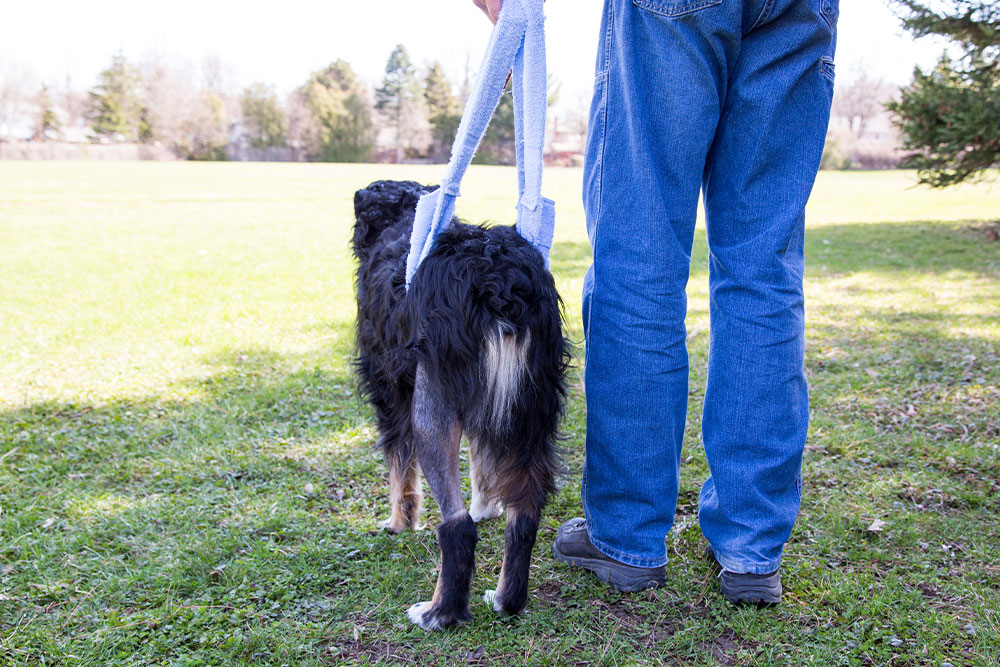
A lifting harness is one of the most useful tools for the early recovery period; it lets you support your dog’s weight on stairs, getting up and down, or going outside without straining the surgical site. An e-collar is essential for the first 10 to 14 days to prevent licking the incision. Some families prefer the Lick Sleeve, a more comfortable alternative that protects the surgical site while letting your dog move and rest more naturally.
At-Home Care During and After Recovery
Crate Rest and Recovery Management
Strict rest in the early weeks is what separates a smooth recovery from a complicated one. We know it is hard. Surviving crate rest is its own challenge for dogs and families alike. A few things help:
- Mental enrichment without physical exertion: food puzzles, snuffle mats, lick mats, frozen Kongs
- Position the crate in a social area of the house so your dog is not isolated
- Stick to a consistent daily routine that includes leash-only bathroom breaks at predictable times
- Use baby gates to expand the rest area gradually as healing allows
- Limit excitement during deliveries, visitors, or when other pets come and go
Maintaining Mobility and Preventing Future Injuries
Once recovery is complete, some habits genuinely reduce the risk of injuring the other knee or developing problematic arthritis:
- Body weight management is the single most effective intervention. Weight control reduces joint load and slows arthritis. We are happy to set realistic goals during a wellness visit.
- Joint supplements: hip and joint supplements and omega supplements provide ingredients (glucosamine, chondroitin, EPA/DHA) that support joint health long-term.
- Warm-ups and cooldowns: five minutes of leashed walking before and after vigorous play reduces injury risk substantially.
- Indoor surfaces: hardwood and tile are slippery. Runners or yoga mats in high-traffic areas help dogs with weakness or arthritis stay sure-footed.
- Avoid high-impact movements: repetitive ball-chasing, jumping for frisbees, and jumping in/out of vehicles all stress the knees. A ramp for the car helps many post-surgical dogs.
Frequently Asked Questions About CCL Injuries in Dogs
How long until my dog can run again after TPLO surgery?
Most dogs are cleared for off-leash activity around 4 to 6 months post-op, depending on healing and rehabilitation progress. Some dogs return to full function sooner, but rushing the timeline raises the risk of complications.
Will my dog tear the other knee?
The risk is significant: roughly half of dogs who tear one CCL go on to tear the other within 1 to 2 years. Maintaining lean body weight and consistent activity helps reduce that risk.
Is TPLO the only option for big dogs?
It is not the only option, but it has the best long-term data for medium and large breeds and is what we most often recommend. We will talk through alternatives if your dog is a candidate for them.
Can my older dog still have surgery?
Often yes. Age alone is not the deciding factor; overall health, activity level, and quality of life are more important. Many senior dogs do extremely well after CCL repair.
What if surgery is not in the budget right now?
We understand. There are payment options, financing programs, and a conservative management plan that can keep your dog comfortable while you weigh next steps. The most important thing is to get an evaluation so you know what you are working with.
Long-Term Joint Health After a CCL Injury
Recovery from a CCL injury is not one big event followed by a return to baseline. It is a sequence: recognizing the injury early, confirming what is actually going on, choosing the right treatment, committing to the rehabilitation, and building habits that protect the joints for the rest of your dog’s life. Each step matters, and dogs whose families follow through on all of them consistently do remarkably well.
We are here for the whole sequence. From the initial limping evaluation through surgery, rehabilitation, and the years of joint maintenance that follow. Schedule a visit any time, and we will work with you to keep your dog moving, comfortable, and doing what they love.