

Whether a broken bone in your pet heals with a splint or needs surgical repair with pins or plates depends on which bone is involved, where the break sits, your pet’s age, and how stable the fracture is. Clean breaks low on a leg in a young, growing pet sometimes heal well in a splint or cast, while a break higher up, one that enters a joint, or a bone in multiple pieces almost always needs internal fixation to heal straight. Fractures are painful and unstable, so the right answer comes from imaging and a hands-on exam, not a guess at home. The reassuring news is that modern orthopedic repair gives most pets a full return to comfortable, active life when the break is treated promptly.
As a family-owned practice on California’s North Coast, Arcata Animal Hospital can move fast on a suspected fracture during our regular hours, starting with pain control, a physical exam, and in-house digital X-rays to see exactly what the bone is doing. From there we walk you through whether your pet’s break is a candidate for splinting, internal fixation, or advanced orthopedic surgery, and we layer in rehabilitation tools like therapeutic ultrasound and PEMF therapy once the bone is stable. If your pet is non-weight-bearing, has visible swelling, or you saw the injury happen, please give us a call so we can prepare for your arrival.
Key Points on Broken Bones
- The right fix for a fracture depends on which bone broke, where the break sits, your pet’s age, and how stable the bone is, which is why imaging and a hands-on exam come before any treatment plan.
- Some clean, low-limb breaks heal well in a splint or cast, while complex, unstable, or joint-involving fractures usually need surgical repair with an orthopedic surgeon using pins, plates, screws, or external fixators to heal straight.
- Puppies and kittens have soft growth plates that need special handling, and with the right approach most young pets heal and go on to develop normally.
- Recovery is where families do the heavy lifting, so strict rest, pain control, mental enrichment, and structured rehabilitation matter as much as the repair itself.
How Do I Know If My Pet Has a Broken Bone?
A broken bone usually announces itself loudly: sudden limping, refusing to touch a paw to the ground, a limb held at an odd angle, swelling, or a sharp yelp when the area is handled. Some pets go quiet and hide instead of crying out, so a normally social dog who tucks under the bed deserves attention too.
You know your pet’s normal. When that changes overnight after a tumble off the couch or a scuffle in the yard, trust it. Those sudden shifts are the everyday signs of broken bones that send most families looking for help. Cats are especially good at masking pain, so a cat who stops jumping to favorite perches or grooms one leg obsessively may be telling you something is wrong.
Where do these injuries come from? Trauma from a fall, a car, or rough play is the most common cause, though weakened bone from disease and the soft growth plates of very young pets shape how a fracture happens and how urgently it needs attention. A tiny kitten’s leg can snap under pressure that an adult cat would shrug off, and an older pet’s bone can give way from an underlying problem after a minor bump.
If you suspect a fracture, keep your pet calm and confined and call us right away so we can guide you on safe transport and have pain relief ready when you arrive. Moving an injured pet the wrong way can worsen the break, so gentle handling matters from the first minute. Don’t try to splint it yourself at home, since wrapping a swelling injury too tightly can cause more problems than the break itself.
How Are Fractures Diagnosed and Treatment Planned?
Diagnosis starts with a careful physical exam and confirmation on imaging, because the eye and the hand can only tell part of the story. X-rays reveal the exact location, the fracture type, how many pieces the bone is in, and whether a joint is involved, and that picture drives every decision that follows.
Once we can see the break, we read the digital radiographs in the context of the whole pet. Age, activity level, fracture complexity, and overall health all steer the plan. A clean crack in a young dog’s lower leg is a very different problem from a shattered femur in a senior cat with other medical concerns.
Broadly, fractures fall into three camps, and the exam plus imaging tells us which one your pet is in:
- Conservative management: Stable, closed, well-aligned breaks in the right location can heal with external support like a splint or cast and strict rest.
- Surgical management: Unstable breaks, bones shattered into multiple pieces, fractures that involve a joint, or ends that will not stay in position on their own need internal fixation to heal correctly.
- Amputation: For especially severe breaks, pathologic fractures (breaks due to disease in the bone, like cancer), or cases where cost is prohibitive, amputation may be the kindest choice.
No two fractures read exactly the same, so we map out the best treatment plan for your pet based on the imaging, the exam, and a conversation with you about your pet’s life and your goals for recovery.
When Can a Splint or Cast Fix a Broken Leg?
External stabilization works best for stable, closed fractures that sit below the elbow or the knee, and it also serves as temporary support to protect a limb before surgery. A splint or cast immobilizes the bone so the two ends stay lined up and healing can begin, and for the right break that is all the help the bone needs.
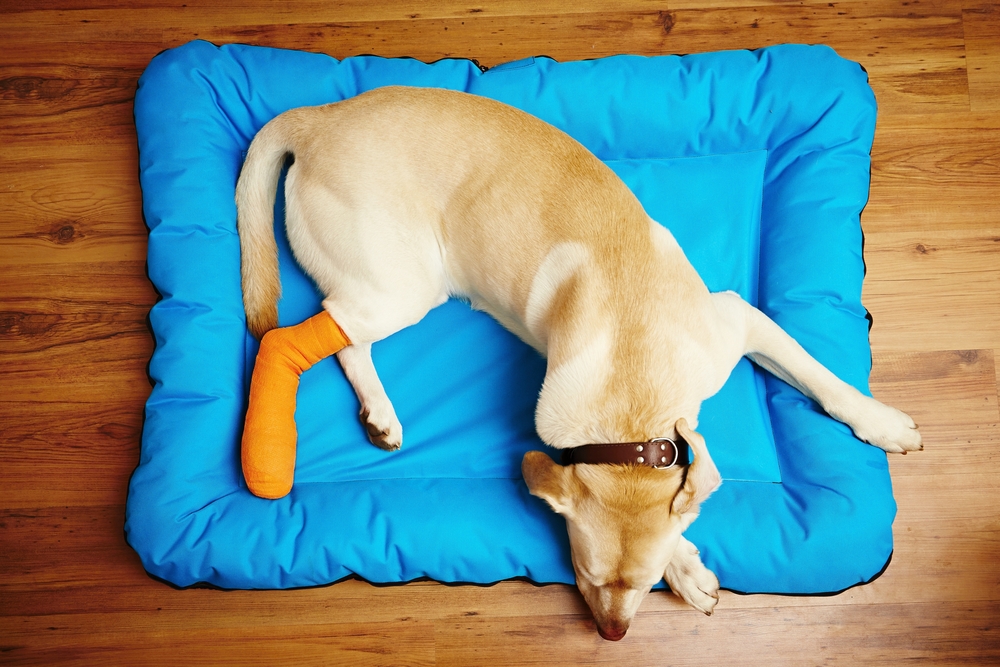
The catch is that splints demand real commitment at home. Proper padding, regular rechecks, and strict activity restriction are non-negotiable, because a splint that slips, rubs, or gets wet can cause more harm than the original break. Here is what good splint care looks like day to day:
- Keep it dry: A wet splint traps moisture against the skin and invites sores and infection, so cover it during bathroom trips and never let your pet swim or wade. A bandage that gets wet and dries out can tighten, causing rubbing or cutting off circulation.
- Watch for slipping or swelling: Toes that puff up, spread, or feel cold, or a splint that has shifted, all mean a same-day call.
- Enforce rest: No running, jumping, or stairs, since a single hard landing can undo weeks of healing.
- Come in for rechecks: We change and reassess the splint on schedule to catch rubbing or pressure sores early.
Call us if the splint smells bad, gets wet, your pet chews at it relentlessly, or the limb seems more painful rather than less. When any of those show up, we would much rather see your pet than have you wait it out.
When Does a Broken Bone Need Surgery?
Surgery becomes the recommended path when a break is complex, unstable, involves a joint, or simply will not hold its alignment in a splint or cast. In those situations, surgical fracture repair locks the pieces back into place, which promotes faster and more predictable healing than a cast alone. Depending on the severity of the break and the type of fixation needed, we may recommend referral to an orthopedic surgeon we trust so your pet has the best outcome possible.
Rigid internal fixation lets the bone heal in the exact position it needs, which protects the joint above and below and gives your pet the best shot at a limb that works like it did before. For these breaks, holding the bone perfectly still from the inside beats any amount of padding on the outside.
What Are Pins, Plates, Screws, and External Fixators?
Fracture fixation is a toolbox, not a single procedure, and the surgeon chooses the tool that fits the break. The hardware itself varies: pins, bone plates, screws, and external skeletal fixators each suit a different fracture pattern, bone quality, and the size and activity level of the pet. An intramedullary pin runs down the hollow center of a long bone like a rod, a plate is screwed flat onto the bone’s surface to lock the pieces together, and an external fixator uses pins that pass through the skin to a frame outside the leg.
Do Puppies and Kittens Need Special Care for Fractures?
Young animals bring one extra wrinkle: the growth plates. These soft zones near the ends of long bones are where bone lengthens as a puppy or kitten matures, and a fracture through a growth plate can affect how that limb develops if it is not handled thoughtfully.
The balancing act is stabilizing the break firmly enough to heal while preserving as much growth potential as possible, which sometimes means choosing gentler hardware or a different technique than an adult would get. The reassuring part is that young bone heals fast and, with appropriate treatment, most puppies and kittens recover and grow up normally.
What Does Recovery and Rehabilitation Look Like?
Recovery is a critical stretch that leans on strict rest, steady pain management, and regular rechecks so the bone can fully knit. Whether the fix was a splint or surgery, this is the phase where diligent home care makes the biggest difference in the final outcome.
Bone heals on its own timeline, and there is no way to hurry it. The repair holds the pieces together, but it is time, rest, and your follow-through that let the bone rebuild itself into something solid again.
How Do I Survive Weeks of Crate Rest With My Pet?
Enforced confinement is honestly one of the hardest parts of recovery, for pets and for the humans watching them bounce off the walls. Getting through weeks of crate rest comes down to comfortable bedding, a calm and predictable routine, and small wins that keep a bored, healing pet from testing the limits of a splint or an incision.
A body on rest still needs a busy mind, and cognitive enrichment toys like food puzzles and snuffle mats burn energy through problem-solving rather than movement. Beyond toys, simple ways to keep a resting dog occupied such as short low-impact training sessions, scent games, and interactive feeders turn a long confinement stretch into structured, tolerable days.
Stick to the medication schedule we send home, and know when to reach out. It also helps to know the warning signs during recovery: rising pain, fresh swelling, or an incision that looks red, chewed, or oozing all mean a phone call rather than a wait-and-see week. We will tell you at each recheck when activity restrictions can safely start to ease, so you are never guessing about when the crate door can open a little wider.
How Does Rehab Help My Pet Get Back to Normal?
Structured rehabilitation helps a healed pet rebuild strength, flexibility, and confidence, and it can smooth the return to normal life after weeks of doing very little. Rehab plans are individualized, and gradual increases in activity are what keep setbacks at bay. We offer comprehensive rehabilitation for dogs and cats, from home strengthening and targeted exercises to laser therapy, ultrasound, and gentle massage that eases stiff, underused muscles.
Even as leash time and activity slowly expand, keeping a healing pet mentally busy helps hold them back from the sudden bursts of movement that cause setbacks. Much of the progress happens between appointments, which is why we build out guided home exercise and stretching so you can keep the work going safely on your own schedule.
Will My Pet Fully Recover After a Fracture?
Most pets recover fully and return to their normal activities after a fracture, provided the break was treated appropriately and home care stayed diligent the whole way through. The fracture’s location, the repair method, and how faithfully the plan was followed do the most to shape the final result.
For most families, life after a fracture heals looks a lot like life before it. A few questions come up in almost every follow-up visit, so here is the honest version:
- Do the implants stay in?: Pins, plates, and screws are usually left in place for life unless they cause irritation, and most pets never notice them.
- Will there be arthritis?: Breaks that involve a joint carry some risk of arthritis down the road, which is one more reason precise repair and steady rehab matter so much.
- Can my pet run and play again?: Most pets return to full activity, though some benefit from lasting weight management and sensible exercise to protect the joint.
Keeping your pet lean is one of the kindest things you can do for a healed limb, since every extra pound is extra load on that bone and joint. We keep an eye on repaired fractures over time with regular orthopedic rechecks that confirm the bone and joint are holding up as your pet ages. For pets carrying some stiffness or arthritis afterward, integrative therapies can help keep them comfortable and moving well for years to come.
Frequently Asked Questions About Fracture Treatment in Pets
How long does it take a broken bone to heal in dogs and cats?
Many fractures take roughly six to twelve weeks to heal enough to bear normal weight, though healing time varies with the pet’s age, the bone involved, and the type of repair. Younger animals often heal on the faster end, while complex breaks or older pets may need longer.
We confirm healing with follow-up radiographs rather than the calendar alone, so activity restrictions lift based on how the bone actually looks, not just how many weeks have passed.
Can a fracture heal on its own without treatment?
A broken bone left untreated is a genuine welfare problem. Without proper alignment and stabilization, the bone may heal crooked, fail to heal, or lead to chronic pain, infection, or a limb that never works right. Even breaks that look minor deserve imaging, because what feels like a bad sprain at home can be a fracture that needs support. Prompt care gives your pet the best chance at a straight, sound, comfortable limb.
How much will fracture treatment cost, and are there options?
Cost depends heavily on the fracture and whether it calls for a splint or an operation, so there is no single number. What we can promise is a clear conversation about the options, from conservative management to internal fixation to referral for advanced orthopedic surgery, along with the trade-offs of each. We will help you weigh what is best for your pet and your situation, and we would rather talk through the plan together than have you avoid care out of uncertainty.
Getting Your Pet Back on Four Feet
A broken bone is frightening in the moment, but fractures are highly treatable with modern veterinary techniques, and most pets go on to run, jump, and play just like before. Early diagnosis, the right choice between splinting and surgical repair, and committed home care through recovery all work together toward a happy ending.
You do not have to figure any of this out alone. Whether your pet needs a splint, orthopedic surgery, or rehabilitation to rebuild strength afterward, our team at Arcata Animal Hospital is here to guide the whole process, from that first worried phone call to the day your pet is back to full speed. If something seems off with your pet’s leg, schedule a visit so we can take a look and get a plan in place.